Children Motivation

All children need motivation. In children, motivation drives the desire to achieve. Children look upon their parents as the key source of motivation to succeed in what they do. Motivated children focus on improving their abilities through personal efforts. These children also have a thirst for information that guides them on how to achieve the best. Motivation also helps the child focus on acquiring a new skill or knowledge.

motivating children

Tips for Providing Children Motivation

  • Provide your child with a stimulating environment and a variety of experiences. This can be done by providing the child with different objects such as books, puzzles, blocks and so on.
  • Give your child toys or materials that he can use to make changes. For example, vehicle toys can be moved from one place to another (change of place). Similarly, play dough can be used to make different objects from the same thing (change of shape).
  • Allowing your child to make his own choices can make him independent and make him feel motivated.
  • Assign your child with age appropriate chores can help him become more responsible and in turn motivated to perform tasks.
  • Assist your child in developing the art of persistence. This is the ability to remain involved in an activity for a long period of time without giving up. A highly motivated child has good persistence and does not give up easily.
  • Be enthusiastic about what your child finds interesting. Talk and ask him as many questions as you can about these interests.
  • Offer your child a variety of challenges that are appropriate for his development. Success in one challenge motivates the child to take up another.
  • Create opportunities for you to join your child in an activity and interact with him. You can use this time that you spend with him to observe and encourage him.
  • Reward your child for a task well done. Remember not to use the reward as a means of getting your child to do the task. Never announce the reward before hand.
  • Allow the child to join you and contribute his views when the family is involved in a decision making process.
  • Start reading to the child from his early skills. Choose a calm, warm and relaxing atmosphere. Reading aloud to him and showing him what you read can enhance his creativity and imagination. Keep the reading session to retain his interest.
  • Make your child understand that each child is different and help him analyse his strengths and weaknesses. Provide your child with opportunities that help him work on improvising his strengths.
  • Assure your child that you trust his ability to perform a task. Let him know that failure does not mean inability to perform.
  • Give your child simple experiments that stimulate his curiosity. You can give him a magnet and encourage him to find which objects “stick on” to the magnet and which do not. Curiosity and inquisitiveness play a wide role in motivating your child.
  • Praise your child when he tries to achieve a new skill. This can motivate the child work on improvising the himself. The praise should focus on the effort rather than the accomplishment.
  • Make reading funny for the child. You can make funny sounds and encourage your child also to do so. Both of you can also act out the characters in the story. This can make him excited about reading.
  • Ask your child to evaluate himself on his accomplishment. Asking him what he thinks of his performance is more beneficial than merely stating that he has done a good job.
  • Allow the child to use different approaches to perform an activity. Children learn how to do something using the trial and error method. Do not criticise the child for his wrong attempt.
  • Instead of telling the child how to do something, show him different possible ways he can try doing it.
  • Give your child opportunities to show others his talent and skills.

How to Know Positive Effects of Motivation in Children

The best way to analyse if your child is motivated is to study his emotions. A motivated child is happy with his performance and enjoys doing an activity. Children without motivation appear bored, quiet and withdrawn. They do not show interest in any activity and complain often. And if you have more than one child, offer experiences based on each child’s needs.

Article source: kidandparent.in

New Bookmarks

Beautiful book markers with motivational Qur’anic ayah. As with all our products, made with recycled materials.

Coming very soon – will be available in November 2012 insha’Allah

BOOK MARKs

Reading The World With Your Kids

Article by writer and teacher Shehnaz Toorawa

Throughout the school year, parents usually ponder the skills that their children need to develop. Many parents choose to practice reading with their children, knowing that better reading skills bring better achievement in school and better understanding of life.

But, you ask, “How, in my hectic schedule, am I going to fit in time to sit down and read with my kids every night?” The solution is not to relegate reading to a specific time and place each day.

CHILDREN READING

Reading can be practiced anywhere and everywhere! Opportunities to practice reading hide in your hectic schedule. Watch for them!

Reading skills can be gained throughout the day: on the drive to school, in the kitchen, at the grocery store, at the mosque, on the computer, at dinnertime. Alongside reading, expand your children’s knowledge of life and train them to deal with it. Here are some ideas:

Scan supermarket shelves. Help your kids check the grocery list, locate the correct aisle, scan product labels, and read ingredients on packages. Teach them how to search for specific ingredients and determine the nutritional value of a product.

Search for signs. As you drive or ride the bus, encourage your kids to read aloud traffic signs, parking notices, and names of streets and stores you pass. Teach them what traffic signs mean.

Navigate a map. Invite your kids to join your search for street names on a map before you head to a new location. Teach them how to navigate streets on a map as you ride the bus.

Check off lists. Have your kids read your grocery or “to do” list and brainstorm additions. Teach them how to organize lists into categories and prioritize.

Flip through the news. Point out bold words, photo captions, and headlines in the newspaper to your kids. Teach them how to skim for important information and question biases in articles.

Stir a recipe. Your kids can read instructions and measure ingredients from a recipe while you cook. Teach them the different measurement scales and their abbreviations.

Browse a menu. Browse the menu with your kids while you wait for food in a restaurant. Teach them how to select healthy items.

Sing along with lyrics. If your kids enjoy nasheeds, find the lyrics so they can read as they listen. Show them that songs are a medium to convey a message.

Follow instructions. Involve your kids when you assemble or learn to operate a new toy, appliance, or furniture. Teach them how to give and follow step-by-step instructions.

Study Qur’an. When your kids recite Qur’an or memorize a du`aa’, encourage them to read and understand the translation. Teach them the context of what they read and how to apply it.

Getting these opportunities to read in different contexts every day, children benefit in many ways:

  • Children learn a skill and use it at the same time, making it real and meaningful. In this way, kids observe that reading has a practical purpose and is a useful skill.
  • When kids read for a purpose, they extend their thinking beyond decoding texts and letters. They engage with the text to make meaning. This deeper processing leads to deeper understanding and deeper retention.
  • Diverse reading opportunities expose children to diverse vocabulary and genres, and promote diverse skills.
  • Kids practice different reading strategies for different purposes. A newspaper, for example, requires different reading skills than a map. This way they learn to negotiate different strategies for different goals.

Variety sparks interest. Kids won’t dread reading if it arrives in fun and unexpected places.

When kids read the world around them, they develop broader skills, interests, and knowledge. Encourage your kids to read anywhere and everywhere.

Source: http://onislam.net/

New Book Samples

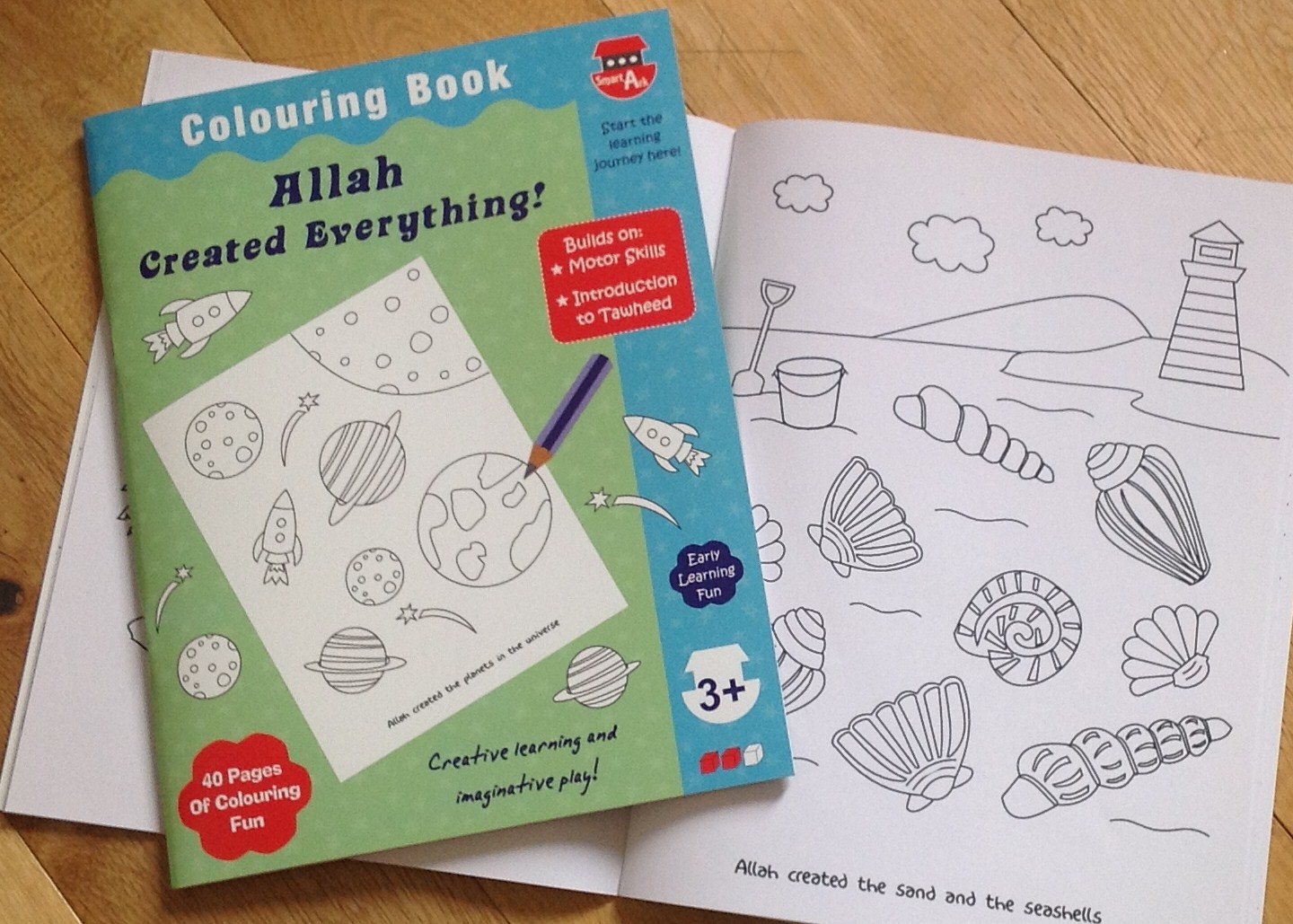
Here is the first sample of the new “Allah Created Everything” colouring book, that we have designed. As always the book is made from paper that is wood free, and made from post consumer waste instead. The colouring book is an ideal introduction to Tawheed and one Allah’s Beautiful Names, “Al Khaliq” – The Creator.

Available in November 2012 insha’Allah.

Allah Created Everything colouring book

How to teach your children to cook

Teaching your children about food safety, ingredients and cooking basic meals like spaghetti Bolognese will not only encourage them to eat more adventurously but give them a useful life skill and the confidence that goes with it.kids cooking

Cooking with children is a daunting experience – it can, after all, be a place fraught with potentially worrying things – sharp edges, hot pans and boiling liquids to name but a few. The best way around these issues, though, is to introduce children to the kitchen at a young age – giving them guidelines but also encouraging their inquisitive nature. If you’re spending plenty of time in the kitchen (and if you’re here, reading this, one can only guess you are), then it won’t be a challenge getting them involved either – and is something you will take great pleasure in. Well, perhaps except for the mess! My sister is due to have a baby in June and I for one know that as soon as the new arrival is able to hold a whisk I’ll be teaching them how to cook.

Safety first

Ok, so it’s not the most glamorous or fun side of getting into the kitchen but it is essential. It doesn’t have to be a set of strict instructions (“you can use that, you can’t ever touch those”) but rather an ‘induction’ of sorts – an encouraging lesson about what does what, the difference between a cake tin and a pie dish and what tools to use for what jobs – mashers, ladles, different spoon sizes, how to make sure your chopping board doesn’t slip… the list goes on. But of utmost importance is it must be positive, not negative. Investigate buying them their own set of tools – there are plenty of companies now manufacturing children’s cookware.

Then there are the hazards – but these can come after the nice bits. The fact that the oven is hot, pans get hot on the hob and what’s in them gets hot too – and that there’s fire involved along with some very sharp edges.

Where to start

Take your children shopping with you too – perhaps the supermarket isn’t the most exciting of venues but a local market is as good as a museum – packed with an amazing array of colours, shapes and flavours – people to talk to, things to look at and bits and bobs to taste. It’ll be a visual treat for, perhaps, both of you – and might even serve as some inspiration for your dinner. It’s lovely for children to watch the transformation of what you buy all the way though into their plate of food.

What to start on

Start with something they like, something that is easy and interactive. This may not be the healthiest of things – starting them off peeling carrots isn’t going to convert anyone to a life of cooking. A cake, for example, is a great way to get children involved – because you’ve also got the fun of decorating it together afterwards. And they’ll love the taste of what they’ve made. Carrot cake is a brilliant example of this – a forgiving doddle in the kitchen, lots of mixing, spices and carrots? In a cake? Has Mummy gone mad? Cookies are simple and fun (a set of exciting cookie cutters will be life-changing) – as are pancakes. They both have the added bonus of not taking ages to cook, either – so no running out of patience!cooking with kids

When to start

The key thing is to start your children off at as young an age as possible – within reason, obviously. Children are visual and like things in pots. They like to tip and stir and crack and knead and touch and taste. Let them do all that.

Get your hands dirty

The hands-on approach is critical. There are fun, useful techniques to learn, like separating eggs or using your hands to mix, knead and decorate – cooking is a hands-on thing. Bread is great for this; you start with a few ingredients, work them by hand, shape them, watch them rise (as if by magic) and then bake them into a golden, crusty, gorgeous loaf.

A couple of final things before you rush off to the kitchen! Take pictures. A visual record of all the things you cook will be lovely for all of the family and provide some entertainment at the same time. You can even set up a video camera and make your own cookery show! And use resources – a quick Bing search and you can find Jamie Oliver’s techniques for school teachers to teach kids to cook which are just as useful for the home-cook.

Lastly, make a plan based on how old they are. The things outlined here are for getting kids in the kitchen at a very young age, but children of any age should be encouraged into the kitchen. They’ll be able to master more advanced techniques quite easily and would perhaps benefit from some inspirational cookery books to read.

Article source: MSN Food

Ramadhan Activity Packs Free To Download

Image

There is nothing quite like the blessed month of Ramadhan. Anticipation hangs in the air as Muslims on every corner of the earth look forward to fasting, with the prospect of becoming closer to Allah and earning His reward. Getting children involved in all aspects of Ramadhan will ensure that they too, have this same feeling of hope and excitement. It’s also an ideal opportunity to spend quality time together and learn about the true meaning of Ramadhan. Here you can download Ramadhan activity packs by Smart Ark and the very talented sis from http://ummmaimoonahrecords.blogspot.com/ who did the lesson plans.


RAMADHAN PACK1


Teach kids with learning disabilities how to make friends

Helping children with learning disabilities build social skills and relationships can have lasting influence on their overall success. Strong friendships are also important for their self-esteem and sense of belonging. Here are some ways you can support them in this area.

1. Making friends with extra-curricular activities

Surprisingly, many children in special education programs do not participate in extracurricular activities, and they miss this important social skills teaching opportunity. Help your child discover his strengths and interests to help him choose the right place for him to learn social skills. Whatever your child enjoys, it is likely there are opportunities to teach social skills in your community and for him to join with others. For social skills teaching ideas, contact community resources such as the local library.kids  play

2. Organized activities help teach how to make friends

Your child will benefit from social skills teaching inherent in social interaction outside the school setting. With your encouragement, even reluctant or shy children can be taught social skills through interaction with others through activities. Many relationships he builds will flow naturally back into the school environment. Just as importantly, non-disabled students will have the opportunity to see your child in successful roles outside of school and get to know him as a friend, rather than an acquaintance.

3. Building friendships in easy-to-manage steps

 Teach your child social skills needed to develop friendships in small, easy steps. Social skills may not come easily for her. Children with disabilities may feel intimidated by other kids, and they may find it too uncomfortable to try to reach out to them. Help your child work on these social skills by setting small goals. Ask your child to smile and greet one new child each day. Just say, “Hi.” This is often enough to reduce the pressure and begin some conversations that build toward relationships. Each night, have a friendly chat about his day, and talk about how many people he spoke to.

4. Making friends takes practice

Teach social skills by rehearsing social situations ahead of time. Role plays meeting a new person with each other. Take turns being the greeter and “greetee.” Teach your child the art of getting others to talk about themselves. Help him see that by doing this, he can learn about his peers and find common interests. Kids can use friendly, polite questions to encourage kids to talk and break the ice. Focusing on others will also help your child feel less self-conscious. Help your child learn how to choose good friends to develop healthy relationships.

5. Game and sportsmanship can teach making friends in advance

Teach your child social skills needed to make friends by helping him learn and practice games and activities at home that are popular at school. Aside from being a good way to practice skills such as reading, counting, and fitness, learning these games will help your child participate in them with other children, while reducing the impact of his learning disability on his ability to play. He will feel more confident and enjoy his interaction with others if he knows the games and can play them with some skill. Consider making your house the hangout for outdoor fun.

6. Schedule fun time to make social skills and making friends a priority

Create a circle of friends by encouraging playtime with a few neighbourhood children. Invest in some quality time and snacks and you’ll cultivate friendships that may stay with your child throughout high school, maybe even for life. Friends from the same class at school can provide important social and emotional support, and not to mention, occasional homework help when a worksheet or assignment fails to make it from school to your house.

By Ann Logsdon, school psychologist.