Good Listening Skills For Parents

Communication is indispensable in any relationship, and good listening skills is an indispensable part of communicating. The good news is that you do not have to be a “born listener.” You can develop these skills no matter how old you are. Active listening is a particularly important skill that will help parents and children feel connected. Parents who actively listen will be fully present (i.e. giving undivided attention to the speaker) and will not be dispensing advice as soon as the child takes a pause.

listen to your child

Benefits of Good Listening Skills

 Good listening skills are basically the ability to listen carefully. This allows you to:

  • better understand your child
  • show your support, care and concern about your child’s condition
  • help resolve your child’s problems
  • answer your child’s questions and
  • uncover the causes and meanings of what your child is saying

Some Things to Avoid

When it comes to demonstrating good communication skills, knowing what not to do is as important as what to do. Here is a list of behaviours that are on the must not do list in many cognitive psychologists’ books.

  • Do not have a hidden agenda or internal dialog that will burst forth during a pause or break in your child’s communication (then you are not really listening)
  • Do not make judgmental statements (e.g. summation statements such as “You are a bad kid”).
  • Do not become defensive and personalize what your child is saying (consider instead what they might be feeling to say such a thing; don’t be afraid to ask them either)
  • Do not use all or nothing statements (e.g. “You always do this”)
  • Do not focus on the negatives (try to recognize your child’s strengths and verbalize this too)
  • Do not resort to blaming or shaming (these only serve to wound and will distance your child from you)

Good Listening Tips

 Here are some tips to exercise good listening skills and demonstrate that you are paying attention:

  • Face your child, maintain an eye contact, and lean toward the child
  • Avoid folding your arms, because this gives the impression that you are already closed off (studies show that you will actually be more close minded too)
  • Turn off the TV or radio, put down the book you’re reading; listen to what your child or has to say; do not listen “between the lines”; give your full attention
  • Be patient when listening (do not rush your child) because listening is all about understanding;
  • Take interest in what your child has to say;  active listening creates a caring environment and encourages your child to speak freely (this will be coupled to the belief that you  will try to understand your child’s situation)
  • Never criticize your child for his or her feelings or emotions. Such criticism will remove the child’s motivation to speak openly to you
  •  Do not say anything until your child has finished the story, you might miss something; equally allow a short pause before carefully responding
  • You should also be attentive to what your child does not say. Be mindful of his or her facial expression so that you can ascertain what your child is trying to convey;
  • Reassure your child (if there is any need), be a trustworthy parent and maintain the confidentiality between you and your child as the case may be
  • Above all, let your children know that they are unconditionally loved even if you do not approve of or agree with their actions.  In these circumstances, they will learn to view your remarks as constructive feedback rather than criticisms that tear them down.

Demonstrating good listening will help maintain harmonious family relationships. It nurtures trust and confidence between you and your child, which is essential to the growth and development of your child and cordial family relationships.

Article source: www.wahm.com

How to Encourage Creative Writing by Mari Amato

Create a time and place for writing. Children will want to write if you make it a fun activity to do together. “Let’s write a story!”

Accept your child’s ideas. Your child may create a character/story you don’t like. Be open, and your child will want to keep writing.

Allow your child to dictate to you. Be a scribe, not an editor. Use your child’s words.

Allow mistakes if your child is writing. The goal is to increase creative fluency and make writing fun. Save the grammar and spelling lessons for later.

Ask questions if your child gets stuck. What is the story or poem about? If it’s a story, who is your main character and what does your main character want?

Talk it through one sentence at a time. If your child has trouble organizing or keeping track of thoughts, ask him/her to tell the story aloud one sentence at a time. Write down one sentence at a time. Model enthusiasm by writing your own creative stories and poems.

creative writing

Encourage all kinds of writing. Stories, poems, jokes, riddles, comic books, cartoons, plays, songs.

Encourage your child to use his/her own voice. Rather than trying to “be poetic,” it’s important for a child to learn to capture his/her own voice.

Create venues for sharing writing. Have a “literary reading” when Grandma comes over, send poems and stories as gifts, help your child submit work to local venues.

Encourage your child to keep a diary. Don’t put pressure to write everyday.

Try a “collaborative” diary or writing journal with your child or your entire family. Leave a notebook out, each taking turns adding to it.

Try a “dialogue journal” just between you and your child. Get a special book, write in it from time to time, invite your child to write in it, and pass it back and forth with your child.

Give the gift of the written word. Model meaningful writing. Write real, meaningful messages in  your own voice to your child for special events. No hallmark cards. Say what is really in your heart. This will make a big impression.

Once a month, have EVERYBODY WRITES night: gather around a table, light a candle, and write a poem or a story or even just a thought.

For encouraging story writing, use my WOW story technique to get started.

What is a WOW story?

WOW is an acronym that I created to help kids remember a simple story structure.

  1. The story has a main character who Wants something. This is the beginning of the story.
  2. There is an Obstacle that gets in the way of the main character. This is the middle of the story.
  3. The main character either Wins or loses. This is the end of the story.

How to make up WOW stories

  1. Choose a main character. This can be a person, an animal, or even an object: for example, a boy, a grandmother, a soccer star, a sock, or a paintbrush!
  2. Decide what the main character wants. What might a paintbrush want? Some paint to play with? To belong to a famous artist? Try unexpected ideas. A grandmother might want to ride a motorcycle!
  3. Decide what will get in the way of the main character’s desire. Brainstorm lots of obstacles and decide which one is the most fun or engaging. Obstacles can be simple. A rabbit wants to eat grass on a hillside, but a tiger lives on that hillside. The tiger is the obstacle. A boy wants a new bike, but his father says no. His father is the obstacle. Obstacles can also be emotions. What if a girl wants to ice skate, but she is afraid that she’ll fall down? Fear is her obstacle.
  4. Decide how/if the main character will “win or lose.” Does your main character get what he or she wants in the end? How?

Write or perform WOW stories

Write or dictate your story: Write your stories on paper. Or make a book by folding pages and stapling them together. If your child hasn’t learned how to write yet, ask him or her to tell you the story and write it down word for word.

Act your story out: For reluctant writers, try acting out the story first. After you have brainstormed the basics for a specific WOW story using the steps above, act out the story. Choose a narrator who will tell the story and provide cues for the actors. This can be the job of the parent or a child. The narrator should be very clear and say “The End” so that everyone knows when the story is over. After acting out stories, the child may be more interested in writing them down.

Source: www.maryamato.com

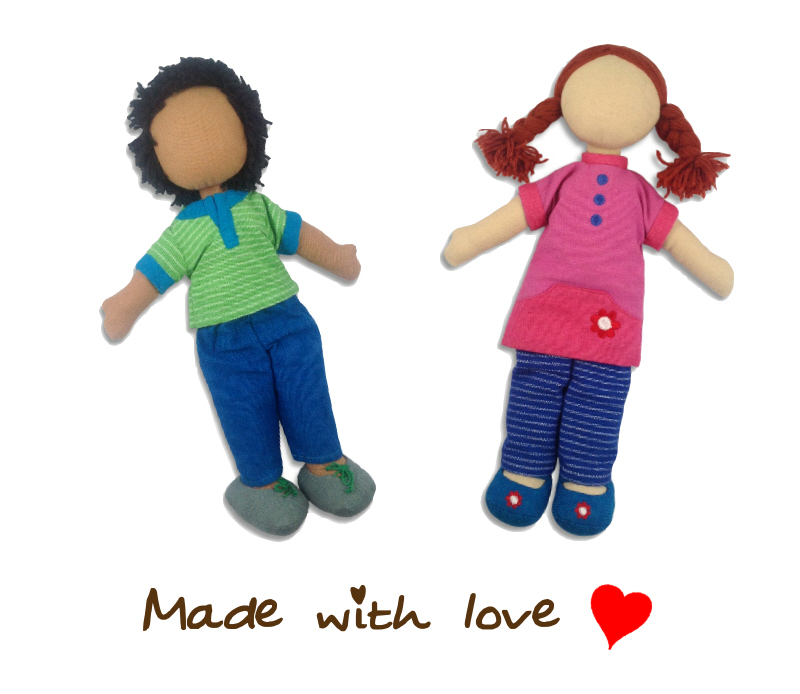
Why our dolls are faceless

Many people have asked why our fair-trade dolls are faceless. While there are many fiqh opinions regarding toys which resemble animate objects, we feel that to be on the safer side and to follow the stronger opinion, our dolls would have no features and be as close to the dolls that A’isha (ra) would have played with.

Hadith: Abu Dawood and al-Nasaa’i narrated from ‘A’ishah (ra) that she said: “The Messenger of Allaah (peace and blessings of Allaah be upon him) came from the campaign of Tabook or Khaybar…” and he mentioned the hadeeth about the Prophet (peace and blessings of Allaah be upon him) tearing down the curtain on which there were images, that ‘Aa’ishah had put over her door. She said: And he uncovered the niche in which were dolls that ‘A’ishah used to play with. He said: “What is this, O ‘A’ishah?” She said: “My daughters (i.e., dolls).” She said: And he saw among them a horse with two wings tied to it and said: “What is this?” I said: “A horse.” He said:  “A horse with two wings?” I said: “Have you not heard that Sulaymaan had horses with wings?” and he smiled. The report mentioned by Ibn Hajar was narrated by Abu Dawood, no. 22813; classed as saheeh by al-Albaani in Ghaayat al-Maraam, 129. 

faceless dollsWe also believe that dolls without features will encourage the imagination of the child, as the doll is not restricted to one facial expression. Unlike plastic molded dolls, with a fixed frozen smile, a child that is playing with a Smart Ark doll can imitate life and different situations. The doll can be sad, happy, and grumpy and can imagine a range of different expressions, encouraging the child to take the lead in creative play.

We are sure that our Smart Ark dolls will become a loving friend to your little one. Not only are our dolls soft, beautiful and well made, we are also proud of the fact that our dolls are certified fair-trade, which means every person that made our dolls have been paid a good wage and work in good conditions. Our dolls are also made by hand loomed cotton which is then dyed in environmentally friendly dyes.

fairtrade

Therefore our Smart Ark dolls are not only inspired by the Sunnah insha’Allah, they are good for the people who have made them, good for the environment and also a beautiful toy for your child!

Raising Independent Children

Independence is an experience that many kids strive for. This is commonly observed since many children often want to get out of their parents’ guiding hands. They want to explore and this is seen at a very tender age.

Parents often feel happy to see that their children learn how to make decisions for themselves. However, one cannot take away the fear of getting the child hurt due to lack of guidance. Adults often see children as fragile, thus, they cannot manage themselves properly. Sometimes, being overprotective is not at all that helpful since it does not develop self-esteem and confidence.

Parents should allow their kids to have some freedom if kids are to be developed. It has been said that freedom and independence should be encouraged in children. Children will be more responsible for their actions if their confidence is developed and this confidence will only emerge if the parents are not overprotective.

Raising Independent Children

Children who do not feel good about themselves are not likely to make decisions. They will always feel afraid of taking ownership and accountability for their actions. Parents should always encourage confidence and boost morale.

Instill Independence Among Children

Independence has a catch. There should be levels of independence granted to children or else they may abuse their newly found freedom. As a general rule, the independent tasks that should be given to children are tasks that they can accomplish based on their age. Continue reading

Talking to my 7 year old son about Gaza

Dawud was watching the screen in tears as he saw children in Gaza hospital (recent tragic events in Palestine). He has always been a sensitive soul, however those pictures would melt even the hardest of hearts.
I did not let him watch the graphic pictures, but I do think it is important for children to know what is going on in the world, especially with the Ummah, even if it is only a more rosier version of events. I certainly don’t want to scare my child, but at 7 years of age, he understands good from bad and right from wrong. He should be encouraged to be curious and learn about different issues and also to question them. He should have an opinion of what is going on around him, and also have a voice, even if it’s only a tiny one.

“Mummy what can we do to help them?” he said, and then he gave me many unrealistic suggestions of how we could save them. I told him that there are lots of different ways people can help. Firstly I told him to never underestimate the power of dua, and continue to ask Allah to help them.
I told him he could give charity. “May be this is your test from Allah to see if you will donate something.” I told him. He decided to donate money he received from Eid.
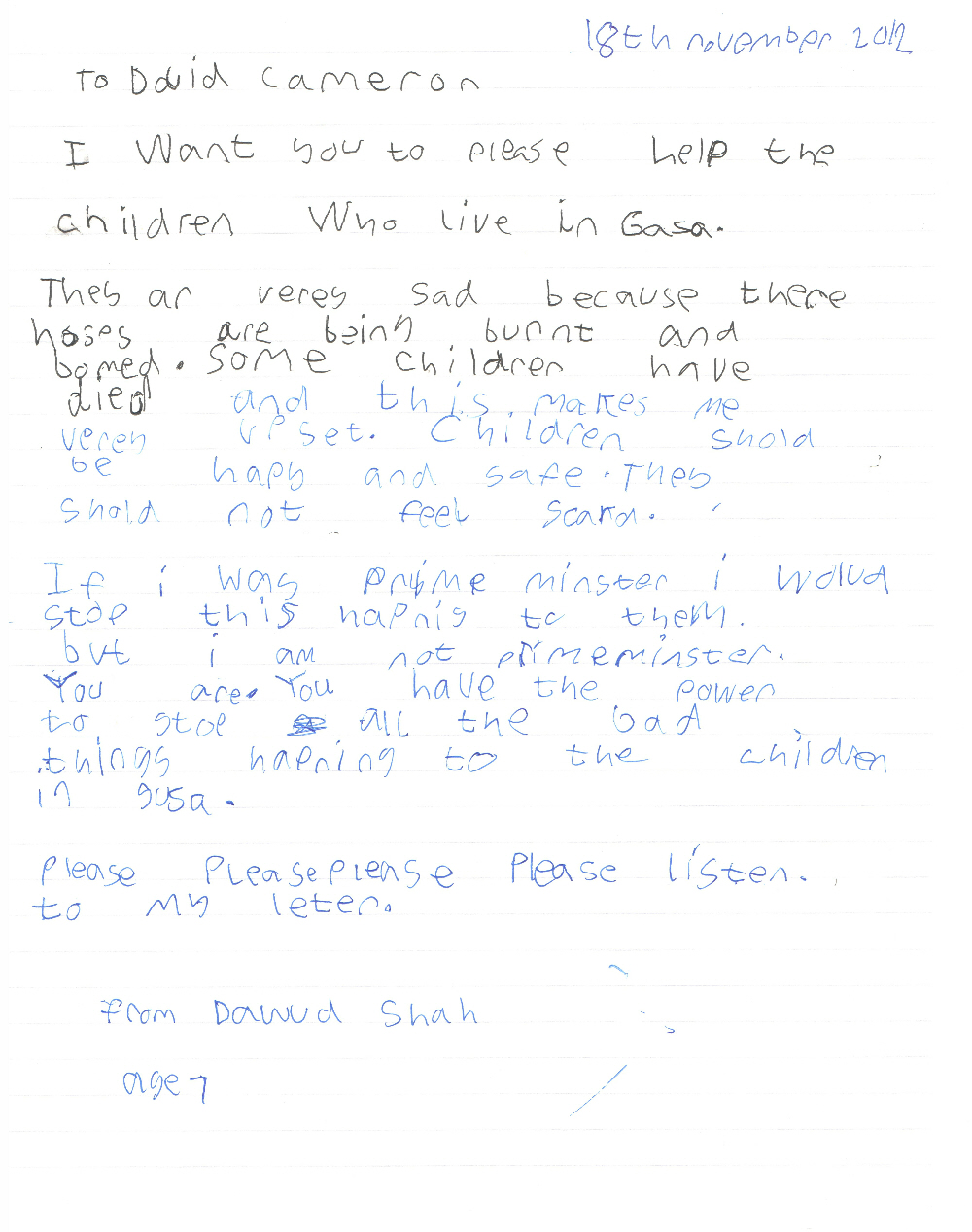
He also wrote a letter to David Cameron (UK prime minister) which, although won’t make a blind bit of difference, it made my son feel as if was doing something.

A 7 year old writes to David Cameron

Fun Days Out On A Budget

There are ways to have fun with your children without your finances suffering. Below are some suggestions for things to do that don’t cost a bean or which cost very little, ideal for making your money go that bit further during school holidays and weekends.

It’s also well worthwhile taking some time out to scour your local listings – you may be surprised that many things to do and places to go don’t come with a hefty price tag…

Root around the charity shops

This activity might incur some minimal cost but if the weather’s not so good this is a great idea to while away a wet afternoon. Take a trip to your local high street and give each child 50p or £1 to spend in the charity shop. If you’re lucky you’ll have a few shops to choose from so the idea is to just have a good root around, unearthing unusual items, books and toys.

Charity shops are often full of hidden little gems and offer you a guilt-free retail experience while your kids get to experience a different kind of shopping. You’ll almost certainly find something: a fun item for the dressing-up box, an interesting book, some fancy costume jewellery or some new cars…think of it as a kind or retail treasure hunt!

Bus around town

A bus trip might not inspire much excitement in you but if you tend to take the car most of the time younger children will find a trip on the bus quite a novelty. From our experience transport-mad little boys will be fascinated by watching the driver and the comings and goings as people get on and off the bus. And few children can resist climbing upstairs to the top deck and securing a front window seat to play at being driver! Children under five usually travel free so you’ll only have to pay your own fare.

fun days out

A trip to the library

Dust off that library card and take the kids off to choose some books, DVDs or computer games. Many libraries run activities for kids, including craft days and story times. DVDs and games may come with an additional charge, but this will be minimal (around £1 – £2 per DVD) and certainly cheaper than your local rental shop.

If you live in the city it might be worth going to your central library where the range will be bigger. Many major libraries are housed in interesting buildings too, so that alone will provide some interest to the kids.

Get down to the garden centre

Garden centres are surprisingly child-friendly. Many of the bigger ones have aquaria, aviaries and nice cafes so you can quite easily while away a morning wandering around and looking at the animals. Most kids love pressing their noses up to the fish tanks and observing all those pretty-coloured fish, especially the tropical varieties – see if they can spot a ‘Nemo’ or a sea-horse!

A stroll through the plant and flower displays is also rather nice, and some centres even have children’s play areas. Top the morning off with a cup of tea and cakes all round at the cafe if you’ve been particularly thrifty all week!

A culture trail at the museum

Museums – especially the big, old ones – are full of excitement for children of all ages. More sedate art galleries are perhaps best saved for older children but like so many places these days the flagship city museums have a relaxed policy towards children and welcome visitors of all ages. Not only that but many museums are free of charge – including some great ones in the capital, such as  the British Museum, National Gallery, Natural History Museum and Tate – so if you find the experience is lost on your children you won’t have wasted any money.

But most children will be fascinated by the varied collections – think dinosaurs, Egyptian relics, Roman coins and stuffed animals! Furthermore, your local museum may also fun specific activity days or culture trails for children, to help the exhibits really come to life, and some have special areas for children, with books, toys and colouring sheets.

A day at the beach

Beaches don’t have to be reserved for the summer. Out of season you’ll have miles of sand almost to yourself, so they’re a great place to burn off some energy with a bracing walk along the shore, or a game of cricket or rounders. Beaches are packed with interesting natural features too – scour the surf for pretty shells and pebbles, or get your wellies on and explore some rock pools.

Nature Trail at the Park

If your children are bored of the local playground why not widen your horizons. More wooded parks are a hotbed of nature to discover so why not go on a nature trail and get the children to look at their surroundings in a little more detail – what can they see when they look into the pond – fish, frogs or dragonflies? Take some paper and do some bark rubbings, collect pine cones to spray and decorate back home, point out the different types of trees and ask the children to find as many different leaf varieties as possible…

Visit the farm

If you live in the city it doesn’t mean your children can’t experience a day at the farm. There may be a city farm in your city – Bristol, for example, has several and London has a whopping 17! They’re usually free of charge and you and your children can wander around, looking at and feeding the animals.

Article source: netmums.com

Reception reading: How your child will learn to read at school

And what you can do to help at home.

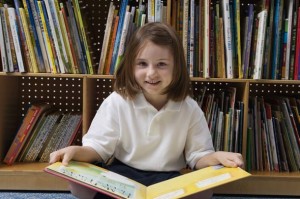
Learning to read is probably the most important thing your son or daughter will do in reception (well, maybe equal with having fun!) but it won’t all happen in class: parents need to help at home too.child-reading

How is reading taught these days?

The way reading is taught has changed over the years, and the current favoured method in British primaries is through phonics. The Government has backed this approach and it’s definitely here to stay for the foreseeable.

So what is phonics teaching all about then?

Whereas many of today’s parents learned to read whole words using the ‘look and say’ method (think Ladybird’s Janet and John series), phonics is a systematic approach to teaching children the sounds that make up words.

Words are broken down into the sounds they’re made up from and then these sounds are ‘blended’ together to make the word.

So, for example, with ‘dog’, children learn the sounds the letters d,o, and g make separately and then how they blend to say ‘dog’.

Note that it’s the sounds the letters make that are important at this stage and not the letter names (i.e. not ‘ay’, ‘bee’ as in the alphabet song etc).

Phonics also helps children spell as they can hear the sounds in a word and then translate them back into the letters needed.
Continue reading