Strong families are built on solid foundations of love, understanding, and communication. Parents who step up to the challenge of building a family foundation do so with foresight and thought. Often times they have written family policies or constitutions that define member roles and outline individual rights and responsibilities that support family values. One way to accomplish this is by writing a family constitution.
Constitutions are agreements between groups of people that serve to organize their interactions and roles and that define the rights and responsibilities of each member. Most people think of constitutions that govern nations of people, but business or charity organizations, religious entities, and even families live by constitutions. The less formal the group of people, the less likely the constitution will be in a written or well-defined format.
Successful groups recognize the need for continuity and definition and are most likely to put thought and effort into writing a formal constitution. Successful families certainly fit in this category.
Groundwork and Foundation
In early publications of this Parenting column, Aisha Al Hajjar wrote many articles that serve as the groundwork for family constitutions.* I’d like to add reference to important religious foundations that should be the building blocks of Muslim family constitutional responsibilities. The following list is derived from the work of Sheikh Najib Al Amir:
- Every family member shall perform their salat (daily prayers) on time.
- Everyone should behave as if Allah (SWT) is watching their actions.
- The Prophet Mohammed (SAWS) is our role model and we should follow his example.
- We should sincerely love one another and make private dua (prayer) for each other.
- We should share our experience and knowledge with each other.
- We should consider ourselves as one team and should encourage each other in good and discourage bad behaviors.
- We should be patient and understanding and avoid anger when dealing with each other.
- We should eliminate selfishness and “me only” attitudes and keep positive dialogue.
- We should specify family time to study deen (religion) together to strengthen our ties to Allah and between our family members.
- Every individual family member represents the family and should respect the family dignity and maintain its pride in the community.
- We should be moderate in our spending. Continue reading

 cursed, so that He has made them deaf and blinded their sight.” [Muhammad 47:22-23].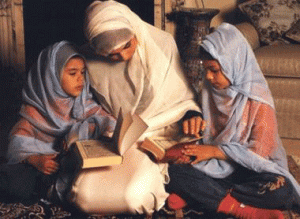
 TEACHING deen (religion) to our children is a huge obligation upon all parents. Generally, Muslim children begin to imitate the movements of salat (daily prayers) long before they are able to speak a word, let alone understand its significance or recite surats (verses of Qur’an), masha’Allah. In fact, as soon as they are able to crawl (9 or 10 months old), children of practicing Muslims will typically attempt to make sujoud (prostration) when they hear, “Allahu Akhbar (meaning Allah is the Greatest, the opening phrase of the daily salat),” or see the prayer rug put down.
  the water around, lower your hand from the opening of the bottle. The oil, being less dense than the water, is sent whizzing out from the vortex you’ve created – your own miniature tornado in a bottle.
  l punishment in Hell.