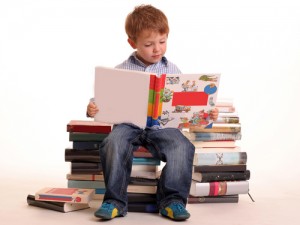
Explain Hajj to your children

Every year Muslims around the world get prepared for Hajj season, and those who intend to perform this holy ritual head to Makkah in a spiritual journey of faith.

In such days, our children get to hear lots of news about Hajj; however, most of them are not aware of many details related to this holy season. When they start to ask about Hajj, some parents find it a little bit difficult for young kids to understand.

In this article, we collect information from OnIslam.net’s counselors in a form of tips to help parents explain Hajj in a simple way to their children.

Hajj

  • Prepare Your Materials
  • Prepare for the Hajj lesson very well before gathering your children for an introductory talk.  Get children Islamic books or articles and read what young kids may say about Hajj. This will help you understand major points to be emphasized in your lesson.
  •  You will  need more than just a talk. You can get photos of Muslims at Hajj, posters, maps, Web sites, book extracts, and video material for instance.
  • Cover These Points in Your Lesson:
  • The five pillars of Islam and where Hajj fits into the five. Hajj is a once-in a-lifetime obligation for  Muslims who have the physical and financial ability to undertake the journey. It is also a form of worship that involves the entire being: body, mind, and soul.
  • The story of Prophet Ibrahim (peace be upon him) and the sacrifice he was asked by Allah to make.
  • Describe Hajj to your children and explain more about the diversity of Muslims who come together to worship Allah, and identify the reasons that Muslims give for undertaking Hajj. Continue reading


Fun autumn things to do

Autumn is one of those seasons that provide great opportunities for outdoor play and creative craft projects. The leaves are beautiful, the weather is (usually) fair and the parks are an ever-changing treasure trove of natural wonders just waiting to be explored.Autumn fun outside

Here are some ideas to help you and the kids enjoy a wonderful Autumn:

Leaf prints

Leaf printing is a lovely experience for little ones and can be enjoyed by all ages. The feel and smell of new leaves is amazing…even brownish ones, past their best have a smell all of their own. Encourage your child to choose lovely leaves with a good, interesting shape (both big and small) then talk about the trees they come from and how different the textures are. You can start small by collecting leaves from the back garden or make the most of a sunny day by exploring the local parks, woodland and forests, collecting as many colourful leaves that you can find.

The best way to do leaf printing is on a flat table rather than an easel. Provide paint and rollers and let the kids loose! Paint can go either on the backs of the leaves, then pressed onto paper OR they can gently roller the backs of the leaves by placing the paint upwards and pressing paper down on top. An alternative idea is to use the leaves to sketch, draw around or rub – all lovely and interesting ways to create their own unique masterpiece.

Autumn collages

Each time you go out, ask your child to collect any interesting leaves, conkers, bark or twigs that interest them and store them at home in a box or bag. Once they have a healthy collection in place, set out some paper, glue and craft materials and help them make a collage. This could be one big collective scattering or you could encourage them to build it into the shape i.e of a tree.   Autumn fun outside

You could add extra materials like coloured tissue paper, string and glitter or let them add colour to the finished article with paints, crayons and felt tip pens.   

Continue reading

Phonics: top 10 tips for Improving your child’s reading ability

Parents have a huge impact on how quickly their children learn to read. Here are top ten tips to improve your child’s progress in reading.

1. Set aside a regular time to read to your children every day.

Studies show that regularly reading out loud to children will produce significant gains in reading comprehension, vocabulary, and the decoding of words. Whether your children are preschoolers or preteens, it will increase their desire to read independently.

2. Surround your children with reading material.

Children with a large array of reading materials in their homes score higher on standardized tests. Tempt your kids to read by having a large supply of appealing books and magazines at their reading level.

3. Have a family reading timeImproving Child Reading.

Establish a daily 15 to 30 minute time when everyone in the family reads together silently. Seeing you read will inspire your children to read. Just 15 minutes of daily practice is sufficient to increase their reading fluency.

4. Encourage a wide variety of reading activities.

Make reading an integral part of your children’s lives. Have them read menus, roadside signs, game directions, weather reports, movie time listings, and other practical everyday information. Also, make sure they always have something to read in their spare time when they could be waiting for appointments or riding in a car.

5. Develop the library habit.

Entice your children to read more by taking them to the library every few weeks to get new reading materials.

6. Be knowledgeable about your children’s progress.

Find out what reading skills they are expected to have at each grade level. Track their progress in acquiring basic reading skills on report cards and standardized tests.

7. Look for reading problems.

Teachers do not always detect children’s reading problems until they’ve become serious. Find out if your children can sound out words, know sight words, use context to identify unknown words, and clearly understand what they read.

8. Get help promptly for reading problems.

Reading problems do not magically disappear with time. The earlier children receive help, the more likely they will become good readers.

9. Use a variety of aids to help your children.

To help your children improve their reading, use textbooks, computer programs, books-on-tape, and other materials available in stores. Games are especially good choices because they let children have fun as they work on their skills.

10. Show enthusiasm for your children’s reading.

Your reaction has a great influence on how hard they will try to become good readers.

Article from: The Telegraph

Family Building Blocks

Strong families are built on solid foundations of love, understanding, and communication.  Parents who step up to the challenge of building a family foundation do so with foresight and thought.  Often times they have written family policies or constitutions that define member roles and outline individual rights and responsibilities that support family values.  One way to accomplish this is by writing a family constitution.  

Constitutions are agreements between groups of people that serve to organize their interactions and roles and that define the rights and responsibilities of each member.  Most people think of constitutions that govern nations of people, but business or charity organizations, religious entities, and even families live by constitutions.  The less formal the group of people, the less likely the constitution will be in a written or well-defined format. Family Building Blocks

Successful groups recognize the need for continuity and definition and are most likely to put thought and effort into writing a formal constitution.  Successful families certainly fit in this category. 

Groundwork and Foundation

In early publications of this Parenting column, Aisha Al Hajjar wrote many articles that serve as the groundwork for family constitutions.* I’d like to add reference to important religious foundations that should be the building blocks of Muslim family constitutional responsibilities.  The following list is derived from the work of Sheikh Najib Al Amir:

  1. Every family member shall perform their salat (daily prayers) on time.
  2. Everyone should behave as if Allah (SWT) is watching their actions.
  3. The Prophet Mohammed (SAWS) is our role model and we should follow his example.
  4. We should sincerely love one another and make private dua (prayer) for each other.
  5. We should share our experience and knowledge with each other.
  6. We should consider ourselves as one team and should encourage each other in good and discourage bad behaviors.
  7. We should be patient and understanding and avoid anger when dealing with each other.
  8. We should eliminate selfishness and “me only” attitudes and keep positive dialogue.
  9. We should specify family time to study deen (religion) together to strengthen our ties to Allah and between our family members.
  10. Every individual family member represents the family and should respect the family dignity and maintain its pride in the community.
  11. We should be moderate in our spending. Continue reading

Art For Education?

Benefitting from Art

When it comes to education, art seems to be the subject that is forgotten and set aside.  How will art help my child? you may ask. Aren’t there other subjects that are more important, that my child should be concentrating on rather than wasting time on painting drawing and making things?

Of course all subjects are important and play a vital role in education and these should not be sacrificed for the sake of art. But the nature of art is that can be beneficial to all other subjects, and can work iBenefit From Artn harmony with them.

Before talking of the subject of art, it is important to point out firstly, when it comes to creating art, as Muslims we must adhere to what is acceptable and what is not, especially with what is on display. Indeed we have the Noble Qu’ran and the Sunnah as a guidance as to what type of images can be depicted, and this is the bases of the art. Therefore it is not so much art for “art’s sake”, rather art for the sake of education and benefitting our children and therefore, for the sake of Allah insha’Allah.

 Tips for parents

When your child starts creating, it is not about the end product; rather the process of creating that end product that is important.

Ask questions about the picture/model, rather than just saying “oh that’s nice”.

Make positive comments, as negatives comments can be highly de motivating.

Pick out a few pieces of your child’s work for display; this will give the child a sense of achievement and satisfaction. Stick it on the fridge or frame it in a room or even upload as a desktop for the computer.

If it’s a model, let it be a talking point.

Integrate art with curriculum at every opportunity, including Islamic studies. Art can be a wonderful way of teaching tawheed, learning about the masjid and the rich history of Islam. Continue reading

Have You Talked With Your Child Today?

Have you had a meaningful conversation together? Do you know what your child accomplished today, how he may be feeling, whether or not he has any concerns? Does your child know that you care about him?

 In Islam, the ties of kinship and family are very strong and something that will always be present throughout our lifetime. There are very serious consequences for someone who decides to break these ties.

 Allah, subhanahu wa ta’ala, says, “Would you then, if you were given the authority, do mischief in the land, and sever your ties of kinship? (22) Such are they whom Allah has Have you talked to your child todaycursed, so that He has made them deaf and blinded their sight.” [Muhammad 47:22-23].
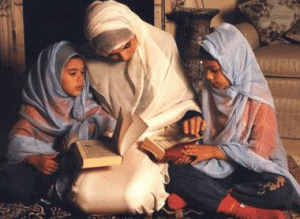

 The Prophet, sallallaahu alayhe wa sallam, said, “Whoever severs the bonds of kinship will not enter Paradise” [Bukhar and Muslim].

A major component of our familial ties is communication. In fact, without communication there would be little connection between people. Living together in the same household with limited, or even hostile, interaction would not fit the criteria for maintaining the bonds of kinship. To develop meaningful relationships within our families we need to know how to communicate effectively and sincerely with each other. A large part of this involves skills and principles that can be learned through practice and sincere effort. The following is a guide to strengthen these ties that bind. Continue reading

Respect For Our Daughters

A person’s need to feel import is something perfectly natural, something instilled in human nature. It may well be that this feeling is behind many of humanity’s greatest inventions, achievements, and noble acts.

This is why Allah mentions to us that Abraham (peace be upon him) said: “And ordain for me a goodly mention among posterity.” [ Sûrah al-Shu`arā’ : 84]

Prophet Muhammad (peace be upon him) said: “If a son of Adam dies, his good works come to an end except for three: charity that keeps providing benefit, knowledge that people still benefit from, and a pious child who supplicates for him.”

This is an indication that people like to feel that they are important, and feel that they will be valued and that their works will endure even after they die. This is why the Prophet (peace be upon him) guided us to continuous charity, enduring beneficial knowledge, and a pious son or daughter who prays on our behalf.

Those who belittle and deride others, and who defame their characters, do not profit themselves anything but pain and bitterness. It makes no difference whether they are officials, educators, parents, or anyone else.
Respect for our daughters
Our society is in need of programs to teach people this basic truth. All too many people have inherited from their cultures – and this is a fact for many societies throughout the world of which some are Islamic societies – contempt for women, looking upon the woman her as if she is a creation of a lesser degree, a second class citizen – and in some cases it seems that they treat her more as if the phrase “tenth class” would be more appropriate. Continue reading

Teaching Children The Five Pillars

Teaching children about the five pillarsTEACHING deen (religion) to our children is a huge obligation upon all parents. Generally, Muslim children begin to imitate the movements of salat (daily prayers) long before they are able to speak a word, let alone understand its significance or recite surats (verses of Qur’an), masha’Allah. In fact, as soon as they are able to crawl (9 or 10 months old), children of practicing Muslims will typically attempt to make sujoud (prostration) when they hear, “Allahu Akhbar (meaning Allah is the Greatest, the opening phrase of the daily salat),” or see the prayer rug put down. Continue reading
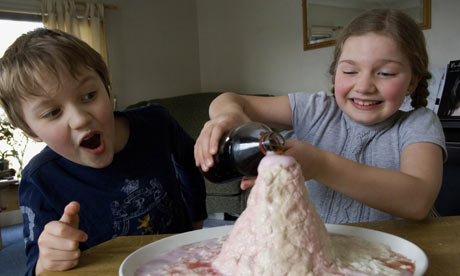
The best kitchen science experiments

Kitchen Experiments:
Creating tornadoes, setting off volcanoes, growing edible crystals: these exciting experiments require only the most basic of ingredients found in every kitchen!

1. Create your own tornado

A simple but impressive experiment to get you and your children started. All you need is an empty 2-litre drinks bottle (a glass one is best but a plastic one will do), a little olive oil and some water. Fill the bottle very nearly to the top with water. Pour in a tablespoon of olive oil. Cover the top of the bottle with one hand and tip it upside down (you may want to do this outside or over a sink). Rotate the bottle in a clockwise direction (if using a plastic bottle, try not to squeeze a dent in it). Here comes the tricky bit: whilst continuing to swirl kids kitchen experimentsthe water around, lower your hand from the opening of the bottle. The oil, being less dense than the water, is sent whizzing out from the vortex you’ve created – your own miniature tornado in a bottle. Continue reading

Luqman’s (as) Advice To His Son, As A Guide For All Parents

In Surah Luqman (chapter 31 of the Qur’an), we find the wisdom that Prophet Luqman (alayhee al-sallam) provided to his son.

The Qur’ân contains ten precious advices Luqmân offered his son. Following is the list of this advice offered to Muslim parents, that they may communicate them to their children, family and members of society that they may implement them. If this valuable advise is followed and implemented then we will all be on the straight Path leading to Paradise. Luqmân himself summed up in a few words the way to succeed in this life and on the Day of Judgement.

1. Luqmân warns his son against the greatest injustice man can do. Allâh said that Luqmân said:

“O my son! Join not in worship others with Allâh. Verily, joining others in worship with Allâh is a great injustice indeed.” [31:13]

Luqmân calls his son: “My Son”. To do so catches his son’s attention so that he may listen carefully to his father . Then he calls his son’s attention to Tawhid. “Shirk,” Luqmân said:” Is a great injustice indeed.”

Therefore, the one who associates others with Allâh in worship does injustice to Allâh, the owner and Creator of the universe. A great injustice is also done to the Mushrik: he subjects himself to Allâh’s anger and eternal punishment in Hell.

2. Luqmân reminds his son of the rights of his parents on him:

“and We have enjoined on man to be dutiful and good to his parents. His mother bore him upon weakness and hardship” [31:14]

He describes hardships mothers face bearing children.

“And his weaning is in two years, give thanks to Me and to your parents. Unto Me is the final destination.” [ 31:14]

Luqmân mentions the total dependence of infants on their mothers for two years. Thank Allâh, and then your parents . In not, then the final destination is to Allâh.

“And if they both strive with you to make you join in worship with me others that of which you have no knowledge, then obey them not, but behave with them in the world kindly.” [31:15]

Luqmân tells his son that if the parents are Mushrikîn, then do not follow their way: Allâh’s right comes first by far. Even so. for as long as the live, treat your Mushrik parents with kindness. Continue reading