Teaching your children about food safety, ingredients and cooking basic meals like spaghetti Bolognese will not only encourage them to eat more adventurously but give them a useful life skill and the confidence that goes with it.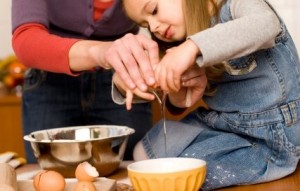
Cooking with children is a daunting experience – it can, after all, be a place fraught with potentially worrying things – sharp edges, hot pans and boiling liquids to name but a few. The best way around these issues, though, is to introduce children to the kitchen at a young age – giving them guidelines but also encouraging their inquisitive nature. If you’re spending plenty of time in the kitchen (and if you’re here, reading this, one can only guess you are), then it won’t be a challenge getting them involved either – and is something you will take great pleasure in. Well, perhaps except for the mess! My sister is due to have a baby in June and I for one know that as soon as the new arrival is able to hold a whisk I’ll be teaching them how to cook.
Safety first
Ok, so it’s not the most glamorous or fun side of getting into the kitchen but it is essential. It doesn’t have to be a set of strict instructions (“you can use that, you can’t ever touch those”) but rather an ‘induction’ of sorts – an encouraging lesson about what does what, the difference between a cake tin and a pie dish and what tools to use for what jobs – mashers, ladles, different spoon sizes, how to make sure your chopping board doesn’t slip… the list goes on. But of utmost importance is it must be positive, not negative. Investigate buying them their own set of tools – there are plenty of companies now manufacturing children’s cookware.
Then there are the hazards – but these can come after the nice bits. The fact that the oven is hot, pans get hot on the hob and what’s in them gets hot too – and that there’s fire involved along with some very sharp edges.
Where to start
Take your children shopping with you too – perhaps the supermarket isn’t the most exciting of venues but a local market is as good as a museum – packed with an amazing array of colours, shapes and flavours – people to talk to, things to look at and bits and bobs to taste. It’ll be a visual treat for, perhaps, both of you – and might even serve as some inspiration for your dinner. It’s lovely for children to watch the transformation of what you buy all the way though into their plate of food.
What to start on
Start with something they like, something that is easy and interactive. This may not be the healthiest of things – starting them off peeling carrots isn’t going to convert anyone to a life of cooking. A cake, for example, is a great way to get children involved – because you’ve also got the fun of decorating it together afterwards. And they’ll love the taste of what they’ve made. Carrot cake is a brilliant example of this – a forgiving doddle in the kitchen, lots of mixing, spices and carrots? In a cake? Has Mummy gone mad? Cookies are simple and fun (a set of exciting cookie cutters will be life-changing) – as are pancakes. They both have the added bonus of not taking ages to cook, either – so no running out of patience!
When to start
The key thing is to start your children off at as young an age as possible – within reason, obviously. Children are visual and like things in pots. They like to tip and stir and crack and knead and touch and taste. Let them do all that.
Get your hands dirty
The hands-on approach is critical. There are fun, useful techniques to learn, like separating eggs or using your hands to mix, knead and decorate – cooking is a hands-on thing. Bread is great for this; you start with a few ingredients, work them by hand, shape them, watch them rise (as if by magic) and then bake them into a golden, crusty, gorgeous loaf.
A couple of final things before you rush off to the kitchen! Take pictures. A visual record of all the things you cook will be lovely for all of the family and provide some entertainment at the same time. You can even set up a video camera and make your own cookery show! And use resources – a quick Bing search and you can find Jamie Oliver’s techniques for school teachers to teach kids to cook which are just as useful for the home-cook.
Lastly, make a plan based on how old they are. The things outlined here are for getting kids in the kitchen at a very young age, but children of any age should be encouraged into the kitchen. They’ll be able to master more advanced techniques quite easily and would perhaps benefit from some inspirational cookery books to read.
Article source: MSN Food